

EFINEA is a molybdenum material supplier stocking commercially pure molybdenum in five forms, with ASTM certification on every order and no minimum order size. Engineers specify molybdenum when a part must maintain its shape and strength at temperatures that would soften most metals.
Stock orders ship within 24 hours of order confirmation, and our in-house fabrication team cuts material to your dimensions before it leaves.
Molybdenum Forms Available From EFINEA
Each listing below gives the stock range we hold and the specification the material ships against.
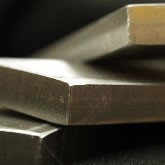
Molybdenum Plate
Plate is stocked in thicknesses from 0.1875″ through 1.500″, conforming to ASTM B386 Type 361. Heavier sections are the starting point for machined furnace components, structural members, die casting tooling, and any part turned or milled from solid rather than formed from sheet. Our in-house waterjet cutting brings plate to your drawing dimensions before shipment.
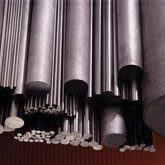
Molybdenum Round Bar | Rod
Round bar and rod covers a wide span, from 0.040″ up to 4.000″ in diameter, supplied in a range of lengths to ASTM B387 Type 361. Smaller diameters serve electrode and pin applications, while the large diameters feed machined nozzle bodies, furnace shafts, and structural hardware. Bar ships with certification, and our team cuts to length so you receive workable blanks instead of full sticks.
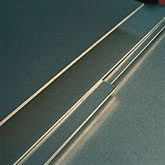
Molybdenum Sheet
Standard grade sheet is stocked in fifteen thicknesses, ranging from 0.005″ to 0.125″, conforming to ASTM B386 Type 361. Sheet is the form behind heat shields, furnace boats, sputtering targets, and formed components where the part starts flat.

Molybdenum Coiled Sheet
Coiled sheet is stocked in 0.005″, 0.010″, and 0.015″ thicknesses, supplied in 30-foot random lengths. Continuous coil suits furnace linings and heat shielding, where a seamless run avoids the joints found in discrete panels.
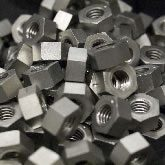
Molybdenum Threaded Rod & Nuts
Threaded rod is stocked in #10, 0.250″, and 0.375″ sizes, with matching nuts in 32-, 20-, and 16-threads-per-inch, respectively. Fasteners inside a hot zone have to be made from the same class of material as the structure they hold, since a steel bolt would fail long before the molybdenum around it. Threaded rod gets cut to your exact length.
Molybdenum Wire
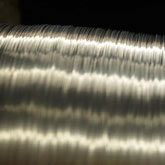
Wire is available in diameters from 0.001″ through 0.100″, supplied to your tolerance, concentricity, and straightness requirements. Fine wire is used in filaments, lamp components, and lead-in wires. Heavier gauges serve resistance heating elements, furnace windings, power tube grids, and support structures that must hold position at temperature.
Why Choose EFINEA as Your Molybdenum Alloy Supplier
Refractory metal purchasing runs on different rules than commodity steel. Mill runs are infrequent, and the certification paperwork follows the part for the life of the program, so the supplier you choose affects your schedule as much as your material cost.
- Inventory across every form: Plate, bar, sheet, coil, threaded rod, and wire are carried in stock rather than ordered against each request. Stock items ship within 24 hours of order confirmation, which can be weeks of difference on a program schedule.
- Documentation that survives an audit: Orders ship with material traceable to the original mill, including heat and lot numbers, chemical analysis, mechanical properties, and conformance to ASTM B386 or B387 Type 361. Our facilities hold ISO 9001:2015 and AS9100D certification.
- Fabrication in-house: Waterjet cutting, shearing, slitting, and cut-to-length are handled by our own team on our own equipment. You can receive plate at finished dimensions or coil slit to width rather than paying a second vendor for the processing.
- Short lead times on non-stock sizes: When a specification is not on the shelf, we work our mill relationships to get it produced rather than turning the order away.
- People who know the material: Our sales team is trained on the alloys we sell. If you are deciding between pure molybdenum and TZM for a furnace component, or working out whether a legacy drawing callout can be filled from stock, you can talk it through with someone who understands the question.
- Sixty years of supply experience: EFINEA has served customers since 1965 and operates four certified locations across New Jersey and California, supplying aerospace, defense, heat treating, electronics, and medical device manufacturers, along with universities and research labs.
What Is Molybdenum?
Molybdenum is a silver-grey transition metal with a body-centered cubic crystal structure. It belongs to the refractory metals, a small group whose melting points exceed that of platinum at 1772°C.
- Symbol: Mo
- Category: Transition metal, Group VI
- Atomic number: 42
- Crystal structure: Body-centered cubic
- Melting point: 2620°C (4748°F)
- Discovered: 1778
Molybdenum’s thermal expansion runs roughly one-third that of stainless steel, so parts hold tolerance through heating and cooling cycles that would move a steel component out of specification. It also has good thermal conductivity and low electrical resistivity, which is why molybdenum serves as both a structural and a current-carrying material.
Other Names for Molybdenum
Drawings and purchase orders reference molybdenum under several labels. A buyer searching for any of the following is usually after the same commercially pure material:
| Name | Notes |
| Mo | Chemical symbol |
| Moly | Common shorthand in shops and procurement |
| ASTM B386 Type 361 | Governing standard for plate and sheet |
| ASTM B387 Type 361 | Governing standard for round bar |
| AMS 7800 | Aerospace material specification |
| UNS R03610 | Unified numbering designation |
| CAS 7439-98-7 | Chemical Abstracts registry number |
| Pure molybdenum, commercially pure Mo | Distinguishes the unalloyed metal from TZM and MoLa |
Note that “Type 361” appears in both the plate and bar standards and is frequently the number a drawing calls out.
Molybdenum Alloys
Pure molybdenum covers most applications, but two alloy grades extend the range when service conditions get harder. As a molybdenum alloy distributor, EFINEA stocks each alongside the pure metal:
- Molybdenum TZM adds small amounts of titanium, zirconium, and carbon. The additions raise the recrystallization temperature by roughly 200°C and improve creep strength, which extends service life in furnace hardware and hot-working tooling that would recrystallize in pure moly.
- Molybdenum Lanthanum Oxide (MoLa) disperses lanthanum oxide particles through the metal. The particles pin grain boundaries so the material holds its shape at temperatures where pure molybdenum would sag, making it the choice for high-temperature furnace components and lamp parts.
Properties, Specifications & Applications
Looking for the technical data? Check out tables of thermal, physical, mechanical, and chemical properties for molybdenum, along with specifications and a full breakdown of its uses here.
Machining Molybdenum

Molybdenum machines with standard metalworking processes require no special equipment to produce accurate dimensions and clean finishes, from simple turned parts through small intricate geometries.
Technique still matters, since the metal work-hardens and has a ductile-to-brittle transition that affects forming.
Our Machining Molybdenum guide covers recommended tooling, lubricants, and machine settings for sawing, shearing, turning, milling, reaming, threading, grinding, and honing, along with electro-polishing and photo-etching techniques.
Data sheets for molybdenum and the rest of our refractory metals are in the Technical Library.
Why Engineers Specify Molybdenum
Lamp manufacturers were using molybdenum by the early twentieth century, where filament supports had to stay rigid at white heat without contaminating the bulb. Modern applications require the same behavior under more demanding conditions.
In a vacuum furnace, hot-zone hardware must withstand thousands of cycles without distorting or contaminating the load. Low vapor pressure prevents molybdenum from evaporating into the chamber at the operating temperature, and low thermal expansion keeps the structure dimensionally stable.
In aerospace and defense hardware, nose cones and rocket nozzles face combined thermal and aerodynamic load where aluminum and most steels have already failed.
In electronics, low expansion allows molybdenum to seal reliably against glass and ceramic, while thermal conductivity dissipates heat away from cathodes and x-ray anodes.
Molybdenum also resists attack by molten glass and many molten metals, making it suitable for glass-melting electrodes and die-casting tooling. What it does not tolerate is oxygen at temperature, so molybdenum runs in vacuum, inert, or reducing atmospheres rather than open air.
For more in-depth information on commercial heat treating, visit the ASM Heat Treating Society, the world’s largest network of heat treating professionals.
EFINEA is a leading Molybdenum & Molybdenum Alloy Supplier, providing high-quality refractory metals and alloys to industries worldwide. Since 1965, our customers have trusted us for personalized service, competitive pricing, and on-time delivery.
Need a reliable source for molybdenum alloys? Request a Quote Today and let our experts help you find the right solution for your needs.
Frequently Asked Questions About Molybdenum
Orders include certification traceable to the original mill, covering heat and lot numbers, chemical analysis, mechanical properties, and conformance to the applicable ASTM standard. If your quality system requires additional documentation, tell us at the quote stage so we can confirm availability before you commit.
Keep material dry and in original packaging until it goes into production. Molybdenum has a ductile-to-brittle transition, so thin sheet and fine wire are easier to crack or kink than the equivalent steel gauge, particularly in cold conditions. Handle coil by the core rather than the edge. Surface cleanliness also matters for vacuum applications, where contaminants can outgas into the chamber.
Give us a phone call at 1-800-348-6268 if you don’t see your size available. When something is not on the shelf, we can often produce it from a heavier stock size through in-house cutting or place a mill order. Lead times for mill production are longer than for stock shipments, so tell us any non-standard requirements early.